Overview
Making emotions visible, shared, and actionable.
Emotional Landscape is a platform that helps people become more aware of their emotions through place, while also seeing and resonating with the emotional experiences happening around them in real time. By combining emotional logging, AI-supported reflection, and a shared message layer, the project transforms private feelings into a collective experience that supports understanding, connection, and response.
Problem & Civic Engagement
Why do students share the same campus, but still feel emotionally alone?
This is not just a private emotional issue. It is a invisible and civic issue on campus.
Our research showed that Berkeley students often understand their emotions, but do not always act on them. Many feel alone because they assume their struggles are unique, while number-based mood tracking fails to represent the complexity of real emotions. At the same time, social interaction can feel too high-friction to begin.
That is where the project shifts from an individual wellness problem to a civic one. Emotions on campus are collective, but invisible: students share the same spaces, yet they do not share perception. Because this emotional layer stays hidden, engagement does not naturally happen.
Civic engagement here means making collective emotional states visible and actionable. The experience is designed to move students through awareness, connection, and action: first mapping their own emotions onto specific places, then recognizing emotional patterns over time, seeing how others nearby feel, and finally responding through reflection, care, communication, or collective support.
Playtest
Testing how students recognize, relate to, and resound with shared emotions.
User Problems of Emotional Perception & Cognition
- Recognition-action gap: Users can name anxiety or depression, but often lack a solution or motivation, leading to rotting or withdrawal.
- Sense of isolation: Users feel alone because they think their struggles are unique; shared struggles or joy help them feel better.
- Numerical fatigue: Stress scores feel abstract, grade-like, and one-dimensional; landscapes, text, and emojis capture emotion more fully.
- Privacy vs. spontaneity: Auto check-ins feel convenient but raise tracking concerns; users want control over when, where, and what they share.
- Social friction: Reaching out can feel like a burden, so users need low-friction ways to signal for support.
User Feedback
- Style: The overall aesthetic feels pleasant and low-pressure, but fonts and web design need more consistency.
- Visuals over data: Landscapes create stronger resonance than raw data; users expect a more AI-driven, fluid experience.
- Dimensional constraints: Energy and Intensity sliders feel limited; users want text or emojis to express different kinds of joy or stress.
- Lack of actionable advice: Insights show what happened, but not how to change, making the page feel like another data tracker.
- Data connectivity: The app feels single-player; users want friends’ emotional landscapes and local area moods with clear sharing boundaries.
- Community expansion: Social features should grow from close friends to people nearby.
- Engagement issues: Users may forget to log; BeReal-style optional reminders could help.
- Gamification: Small tasks are motivating, but rewards are needed for long-term engagement.
Original interview notes
Emotional Baseline
If you used three words to describe your life at UC Berkeley this semester, which would you choose?
PhD: Busy; exhausted; searching for hope.
Graduated: Desperate; tired; lost.
CS Undergrad: Depressed; disappointed; escaping.
Liberal Arts Grad: Leisurely; free; a little sad.
In the past week, was there a moment where you felt especially lonely or felt a strong sense of belonging?
PhD: Yes, when walking home alone at night. No matter how the day was, only loneliness and disappointment remained at night.
Graduated: Waking up and finding no friends on social media, only work messages. I felt lonely and wanted to go crazy, but I didn’t want to bother my friends.
CS Undergrad: Neither. Everything feels normal.
Liberal Arts Grad: Neither.
Have you ever felt like you don’t belong or are not as good as others? When is this feeling strongest?
PhD: Every day. 80% of undergrads say this when I guest lecture. It hits hard when I see others’ achievements. I feel like I just faked my way here, even though I know I’m just focusing on their strengths.
Graduated: I felt it as a freshman, but not anymore. Now I feel like everyone is struggling equally.
CS Undergrad: Maybe 1%. I am more confident now. I used to feel it more, but now it’s very minor.
Liberal Arts Grad: No. I wasn’t afraid of not graduating. I have no desire to participate in school events or fit in.
Can you distinguish between Anxiety and Depression immediately, or does it just feel like a bad mood?
PhD: Yes. I can tell the cause. Sometimes I know the solution but don’t want to do it; other times I don’t know the solution and just give up.
Graduated: Yes. I know the cause but easily fall into self-attack.
CS Undergrad: Yes. I know the cause but either don’t want to fix it or just give up.
Liberal Arts Grad: Not really. I don’t try to distinguish it; I just socially withdraw for a bit.
Is using energy and Intense sliders more accurate than a diary or emojis?
PhD: They serve different purposes. Sliders are too limited.
Graduated: Yes, it is faster and more intuitive for just describing the now.
CS Undergrad: No. A diary provides more detail.
Liberal Arts Grad: No. Numbers only have one dimension. Emojis can show many different layers.
Which resonates more: abstract landscapes or a 8/10 stress score?
PhD: Abstract images.
Graduated: Abstract images. Numbers need extra explanation.
CS Undergrad: Numbers.
Liberal Arts Grad: Abstract images.
Emotional Mapping
Is there a place on campus that makes you feel stressed?
PhD: Stanley Hall, that’s where I work.
Graduated: MLK Building. I don’t like wearing headphones. Seeing others socialize while I struggle to do so creates huge pressure.
CS Undergrad: The Professor’s office. He is very strict and has a bad impression of me, but I need his recommendation.
Liberal Arts Grad: It’s seasonal. Seeing everyone study at Doe Library at night makes me feel pressured to compete.
Do you have a secret base as an emotional refuge?
PhD: Not recently.
Graduated: A lockable room or my lounge.
CS Undergrad: My girlfriend’s house.
Liberal Arts Grad: My bathroom at home.
When at Sproul Plaza, are you curious about others’ moods? Would seeing 60% of anxiety change your feelings?
PhD: No. Most people have nothing to do with me.
Graduated: If I’m feeling down, it might offer some comfort.
CS Undergrad: No.
Liberal Arts Grad: No. I don’t pay attention to it.
Would knowing that others are also breaking down help you heal, and knowing that others are feeling good make you happy?
PhD: I already know many people are, so it doesn’t really help.
Graduated: Yes. People at Berkeley can act fake. It would be less healing in a study area, but seeing happiness might help a little.
CS Undergrad: A little. It provides a sense of belonging; you are not alone.
Liberal Arts Grad: Only if we are anxious about the same thing. Shared happiness doesn’t help me. The emotions must be felt on the same thing.
Do you prefer Auto Check-in or Manually Tossing your emotion onto a general map area?
PhD: Manual. Not precise. Auto feels too mechanical.
Graduated: Auto check-in. I would forget to do it manually.
CS Undergrad: Manual. I only do it when I want to, usually when I’m annoyed.
Liberal Arts Grad: Manual. It depends on my mood. I don’t want fixed check-ins.
Feature
Do you prefer AI-generated landscapes over numbers?
PhD: Yes.
Graduated: Yes, I prefer that. Adding my own text would be even better.
Liberal Arts Grad: Yes.
Would sensing collective emotions via a wearable device be meaningful or distracting?
PhD: I can take it off, so it is acceptable when I choose to wear it.
Graduated: It should be an add-on, not the main feature. But it’s a nice idea.
CS Undergrad: Depends on the occasion.
Liberal Arts Grad: Depends on the occasion.
Would you do a social task, like giving out candy, to purify a high-stress area on the map?
PhD: Is there a reward? I could do it, but I’m not very motivated.
Graduated: Yes, I would participate.
CS Undergrad: No. It’s annoying. I don’t want to change things.
Liberal Arts Grad: Yes. Small activities are fine if the pressure is low.
Would seeing a best friend’s emotional landscape change how you interact?
PhD: Yes, very helpful for social support.
Graduated: Yes. I struggle to perceive others’ true emotions. I would love to help my friends when they need it, provided they consent to share.
CS Undergrad: Good, but it must have an off switch.
Liberal Arts Grad: Okay. I can adjust how I interact based on their mood.
Would you irrigate a shared landscape if it became a desert during finals week?
PhD: Depends. If I realize the anxiety is urgent, I’ll go fix it.
Graduated: Yes.
CS Undergrad: Yes, if I’m not busy and want to relax.
Liberal Arts Grad: Depends on the group size. A large group feels distant. 4-5 people would be better.
Design Decisions
Feature system and product structure.
Based on interview feedback, we expanded the design from a single-player emotional tracker into a more controlled, visual, and socially connected emotional landscape.
First Iteration Proposed feature system
Map
Random Pop-ups
BeReal-style random reminders prompt users to log emotions without making check-ins feel mandatory.
Location Toggle
Precise GPS tracking is off by default, giving users control over privacy before sharing location-based feelings.

Logging Logic
If GPS is off, users manually tap a location. If GPS is on, the logging flow can appear automatically.
People Nearby
Users can see recent emotional logs nearby if shared, while text and emojis stay hidden unless they are friends.
Map Layers
Users switch between Personal, Friends, and Global views. Global shows emotional trends without identities.
Friends Layer
Friends can comment on emotional pins, creating low-friction support without forcing direct outreach.
Limited Zoom Out
Zoom limits keep the experience local and contextual, avoiding a detached or overly broad view of emotions.
Emotional Logging
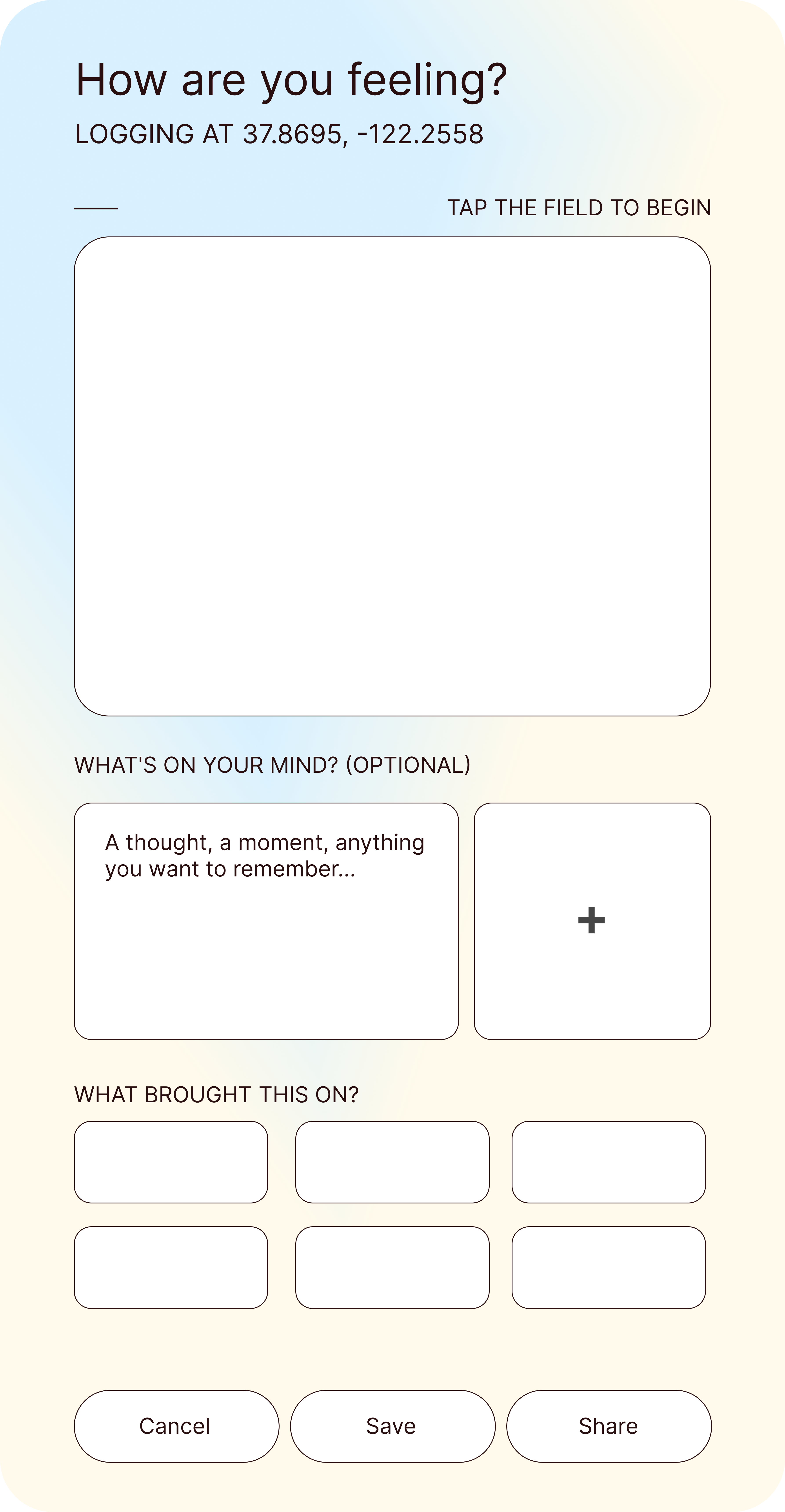
Circumplex Model
A multi-axis emotion model captures more nuance than a single stress score or one-dimensional slider.
Text & Emojis
Users can add text and emojis to express emotional texture beyond numbers, such as different kinds of joy or stress.
Sharing Options
Users choose Friends or People Nearby. Friends see full logs, while nearby users only see limited recent entries.
Personal Insights
Profile
The profile displays name and avatar, grounding emotional data in a recognizable personal identity.

Emotional Landscape
AI generates a personal landscape from logs and offers suggestions, such as noticing when the forest feels grey.
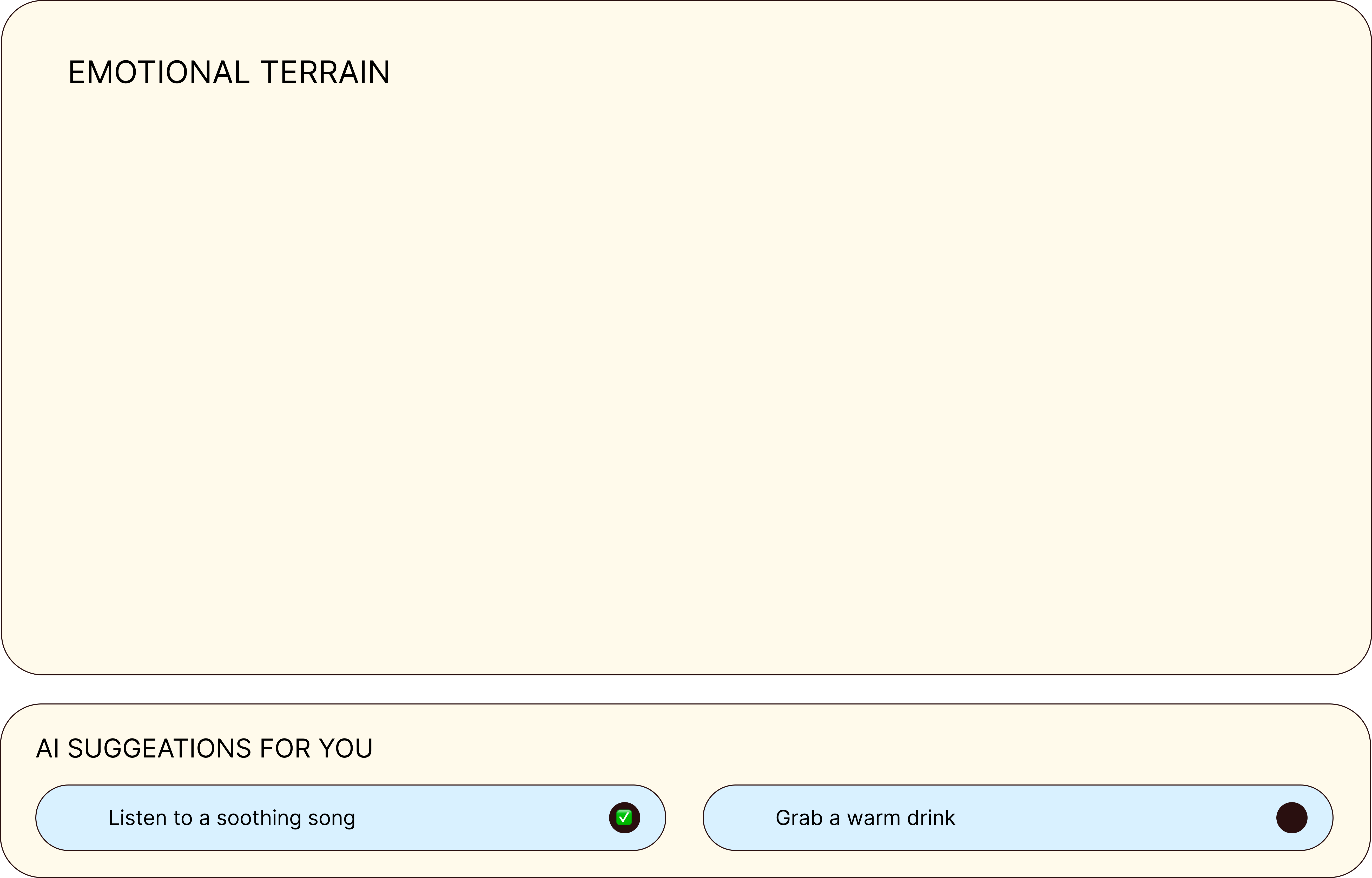
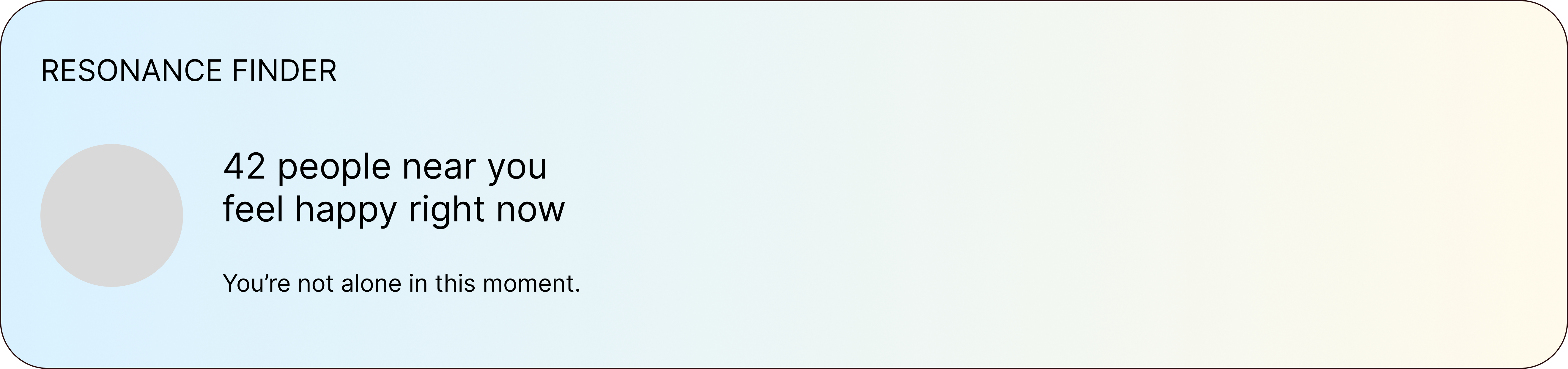
Resonance Finder
Nearby shared emotions reveal resonance, such as how many people around the user also feel happy or anxious.
Journal
A private reflection space lets users add context and meaning beneath their insights.

Chat Bubbles
Small notifications show when friends respond to emotional logs, making support visible but lightweight.
Friend Insight
Profile
Friend profiles display name and avatar, making emotional landscapes feel personal and consent-based.

Friend's Landscape
Users can view a friend's AI-generated emotional terrain to better understand how to support them.
Shared Journal
Shared logs include time and location, and each entry can jump back to the map for spatial context.

Community
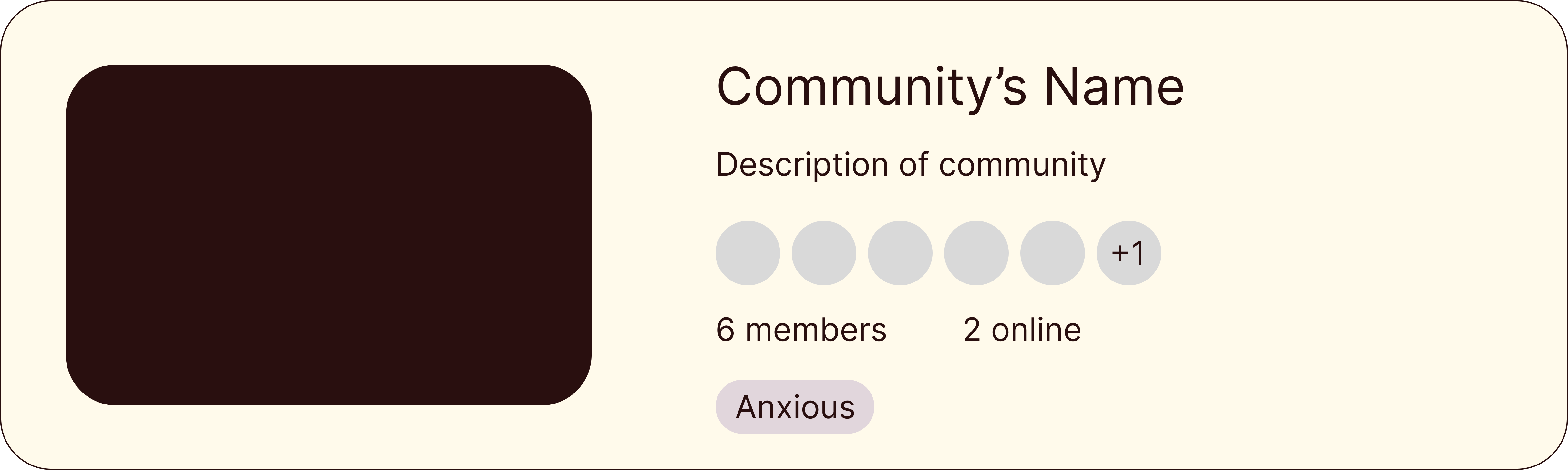
Active Communities
Users can enter existing communities to see shared emotional spaces beyond close friends.
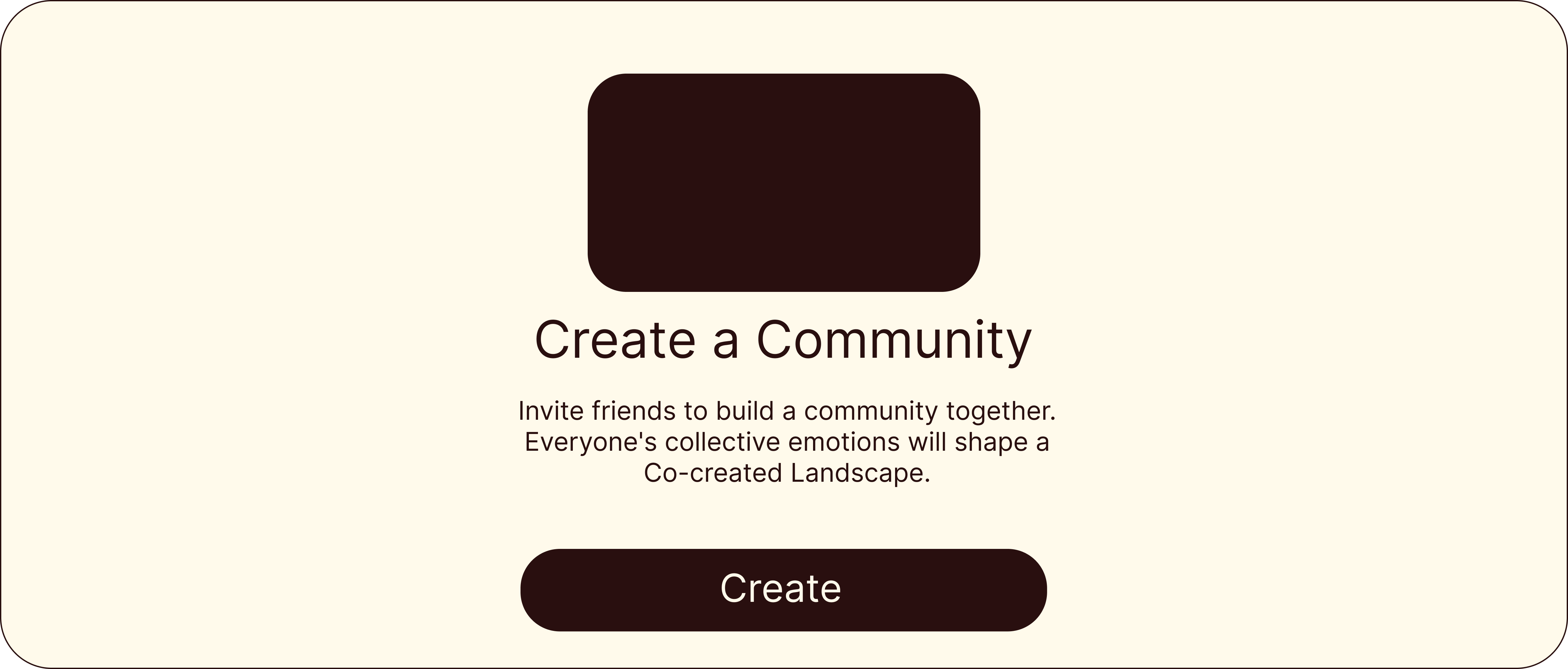
Create a Community
Users invite friends to co-create a shared emotional space around a group, place, or moment.
Active Communities
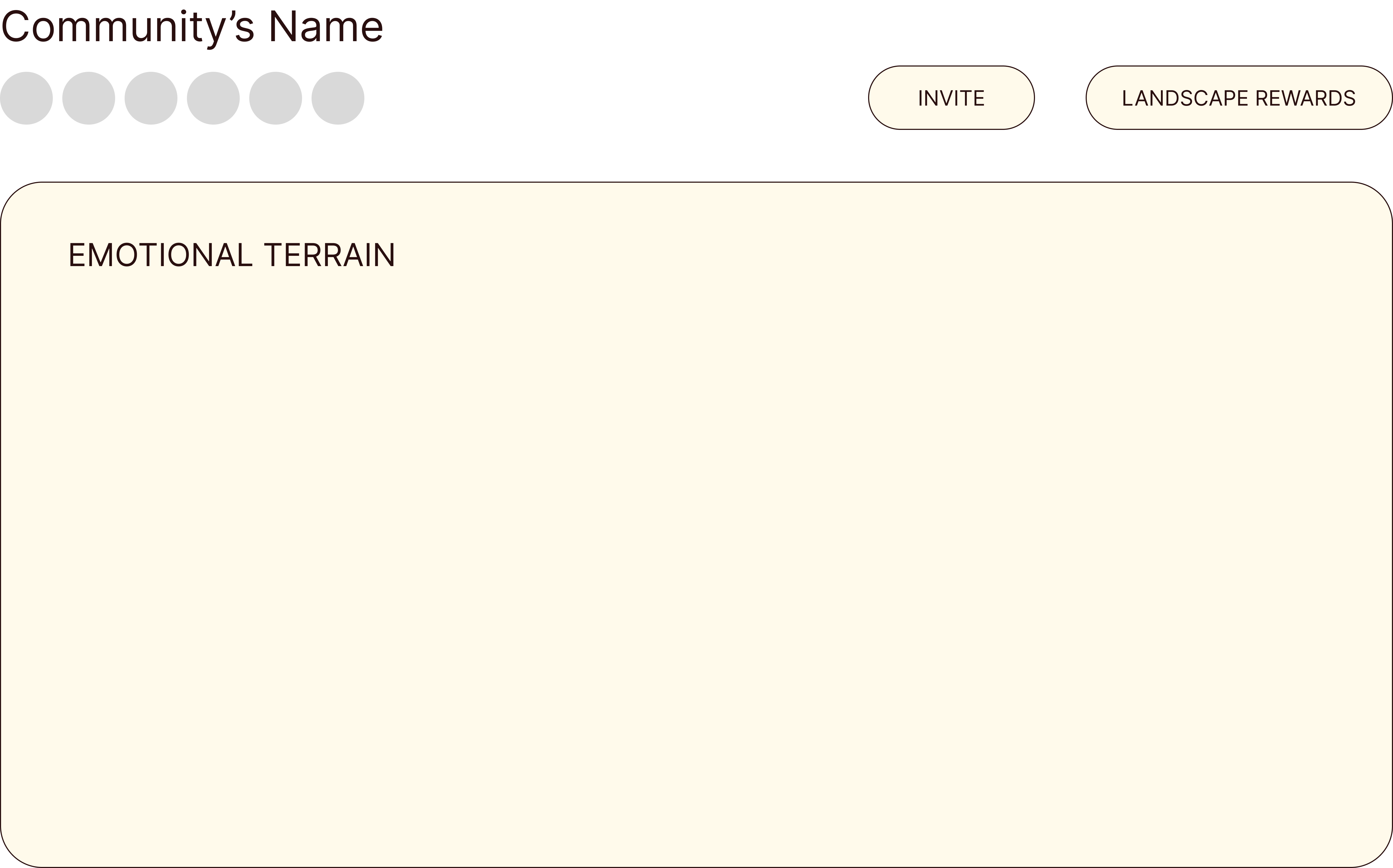
Co-created Landscape
Aggregated emotions form a shared landscape while individual data remains anonymous.
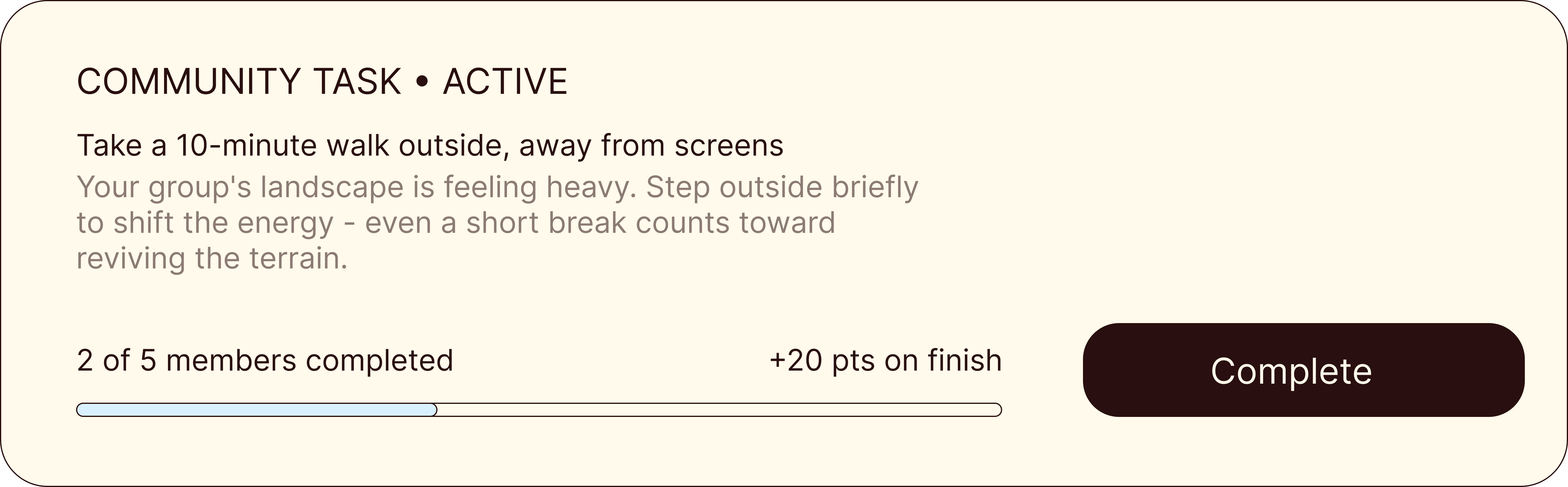
Gamification
AI generates small collective tasks based on group mood, such as reviving a desert-like landscape.
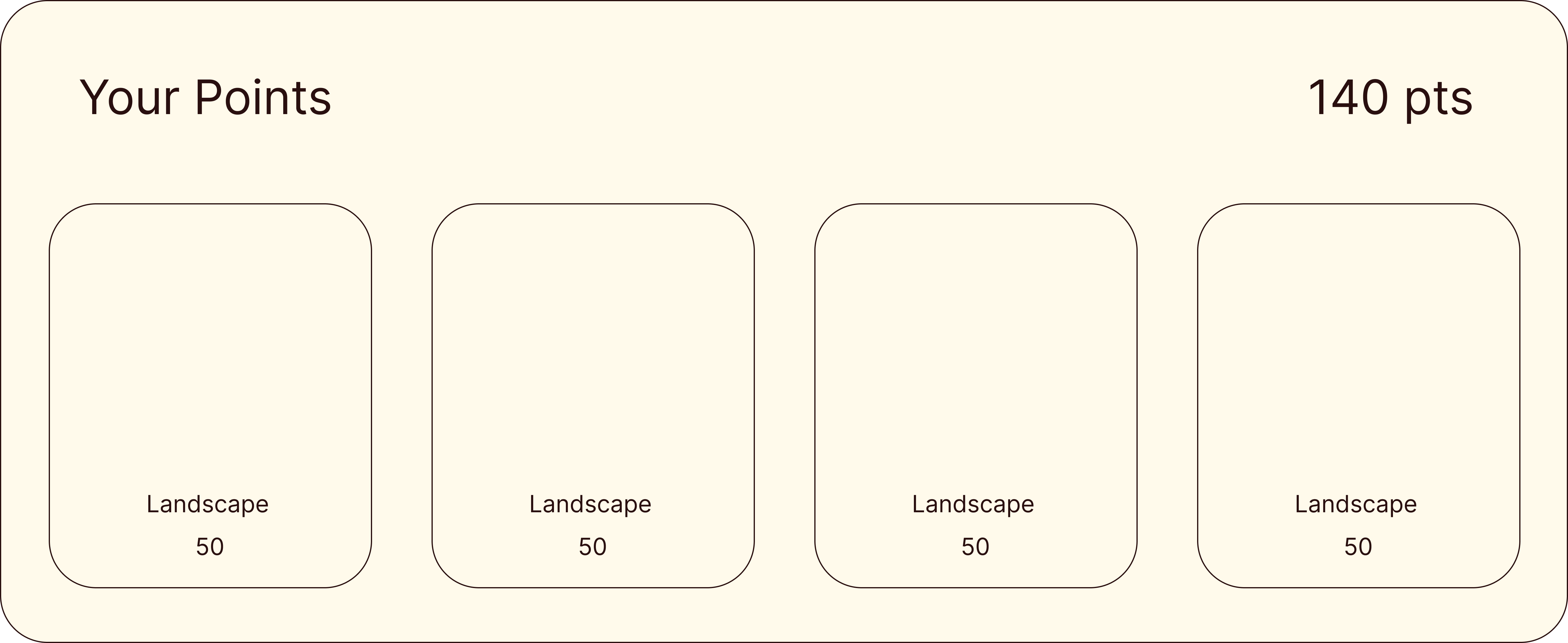
Rewards
Completing tasks earns points that unlock decorative emotional elements for long-term motivation.
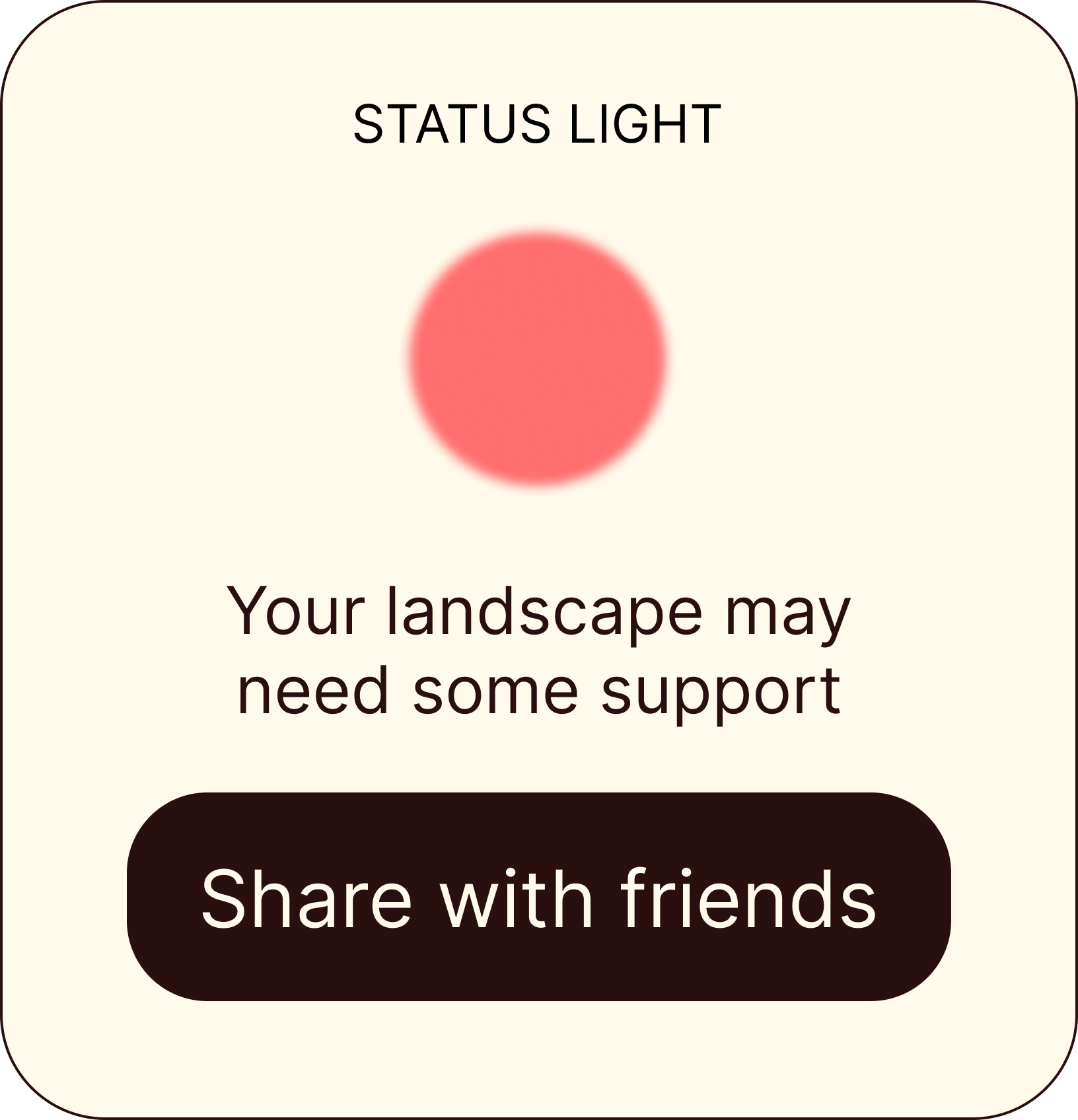
Status Light
A status signal shows when someone may need support, allowing friends to respond with actions or messages.
Second Iteration What actually shipped
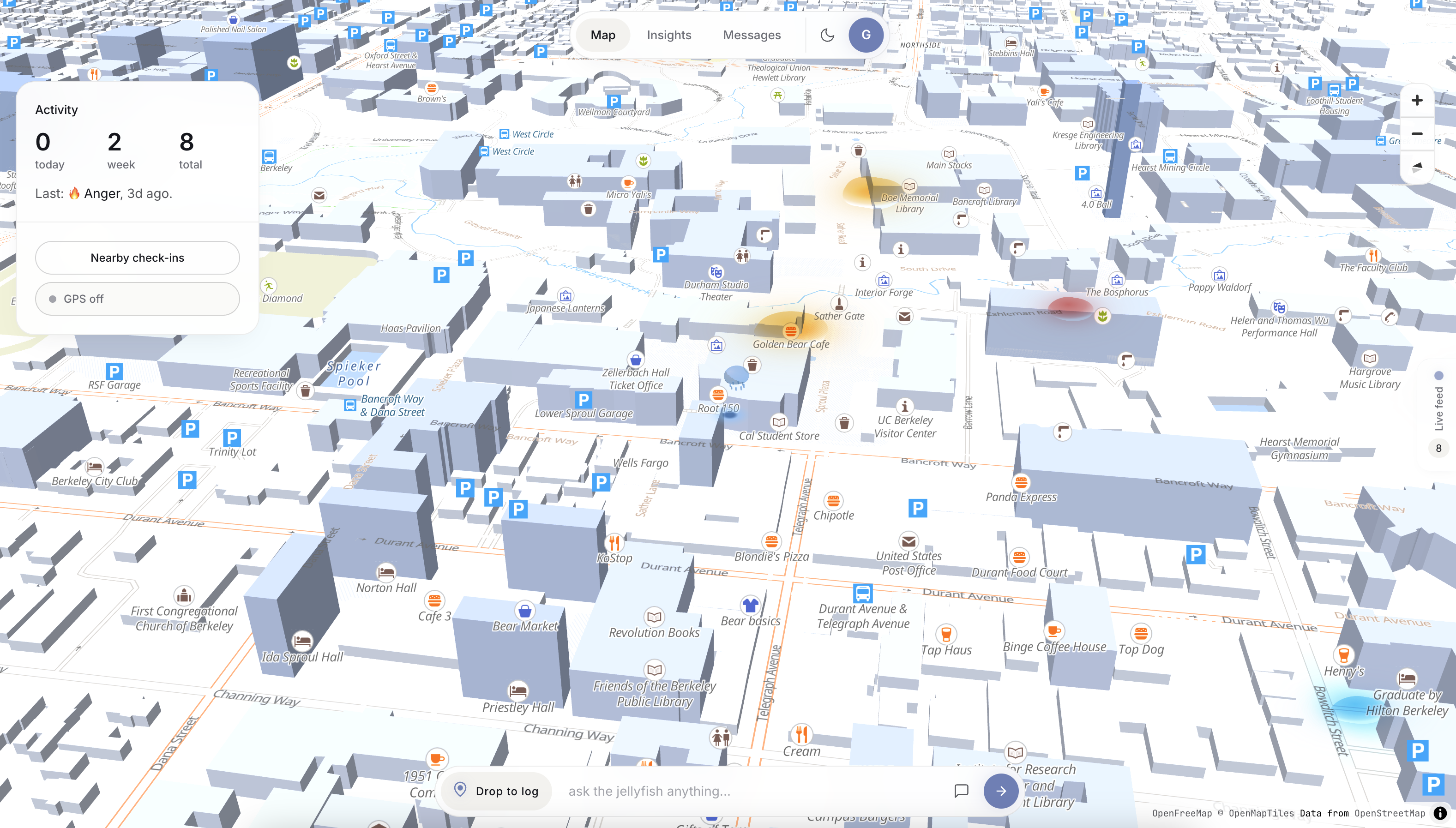
We took a lot of feedback from professors and fellow classmates. We looked to introduce personalizations and resulted in introducing a jellyfish, looking to explore a sea of emotions. From there, color changed to match the jellyfish and the city came alive.
Map
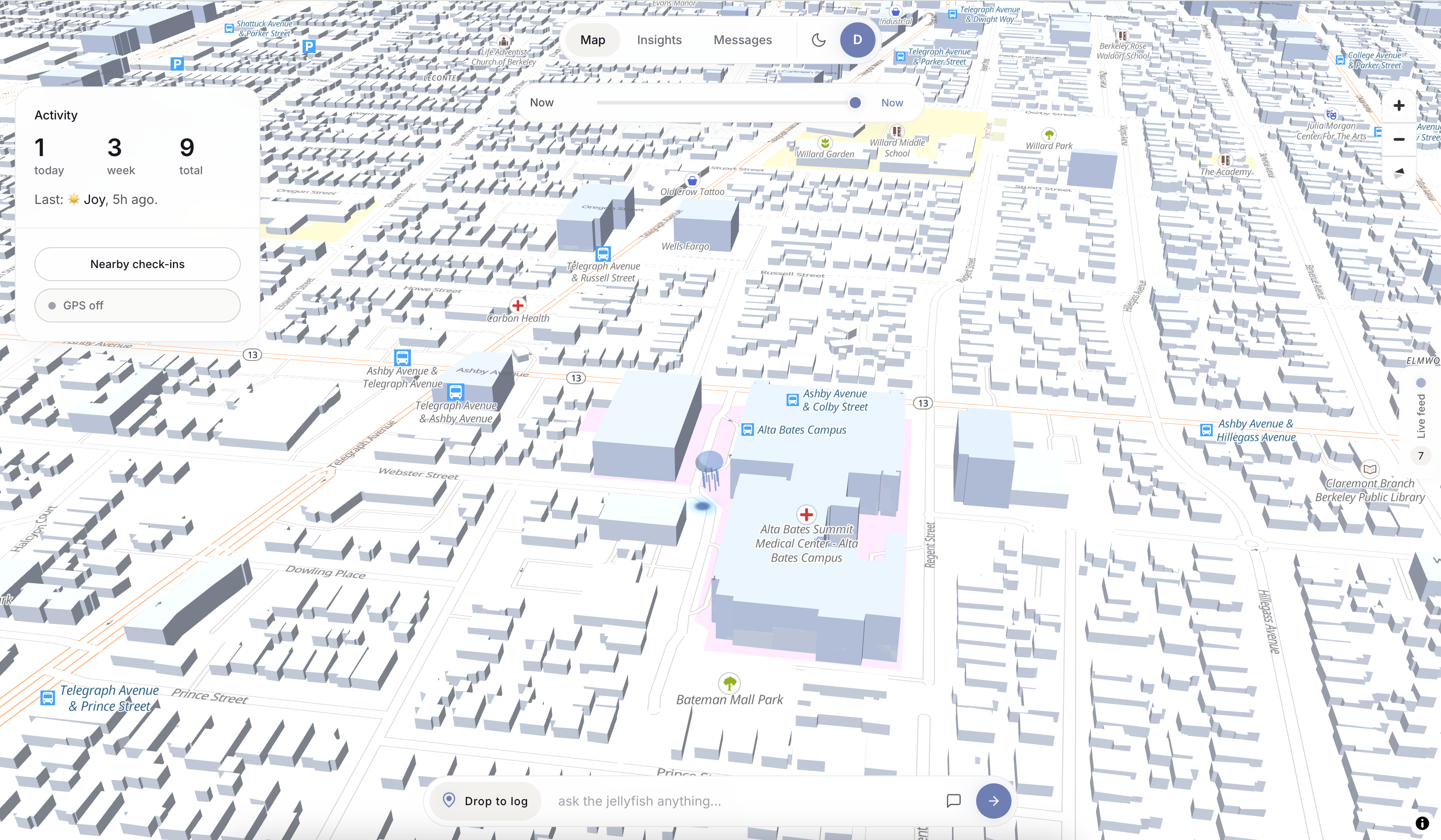
Kept
- Location toggle (GPS off by default)
- Drop-to-log manual placement
- Nearby check-ins
New
- 3D Mapbox terrain
- Time scrubber
- Jellyfish AI companion + chat ("ask the jellyfish anything")
- Activity panel: today / week / total check-ins
- Live feed sidebar of recent entries
Cut
- Personal / Friends / Global map layer toggle
- Friends layer with comments on pins
- Random BeReal-style pop-ups (replaced by jellyfish)
- Hard zoom-out limit
Insights
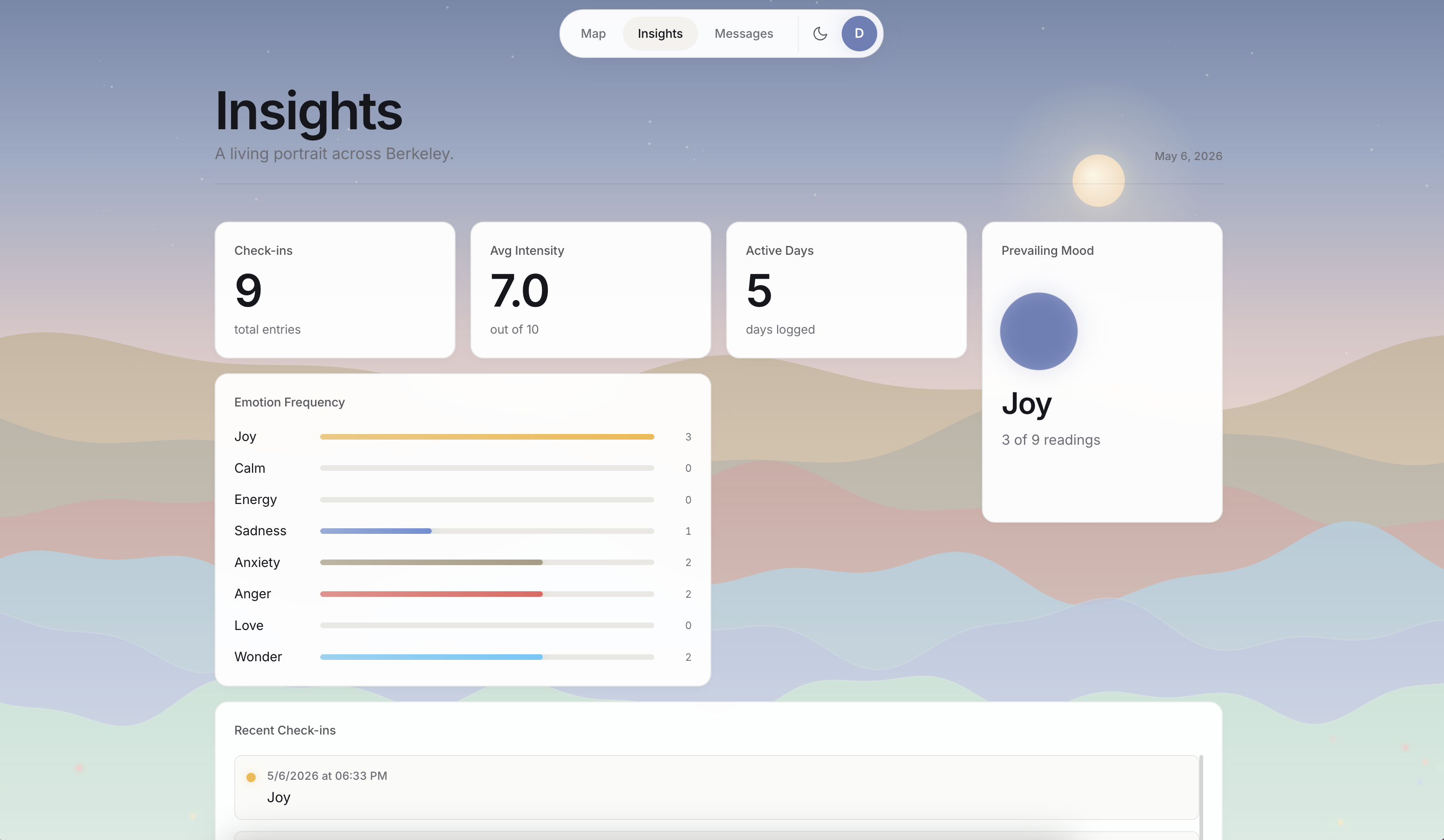
The emotional landscape now embodies the background and houses certain statistics logged by the user.
Kept
- Painterly emotional landscape (now ambient background)
- Personal profile + avatar
- Circumplex model behind the scenes (drives emotion mapping)
- Journal note attached to each check-in
New
- Stat cards: check-ins, intensity, active days, prevailing mood
- Emotion frequency chart across 8 named emotions
- Recent check-ins log with timestamps
Cut
- Resonance Finder as a standalone surface
- Chat bubbles for friend responses
- AI-written suggestions ("the forest feels grey today")
Messages — the Lobby
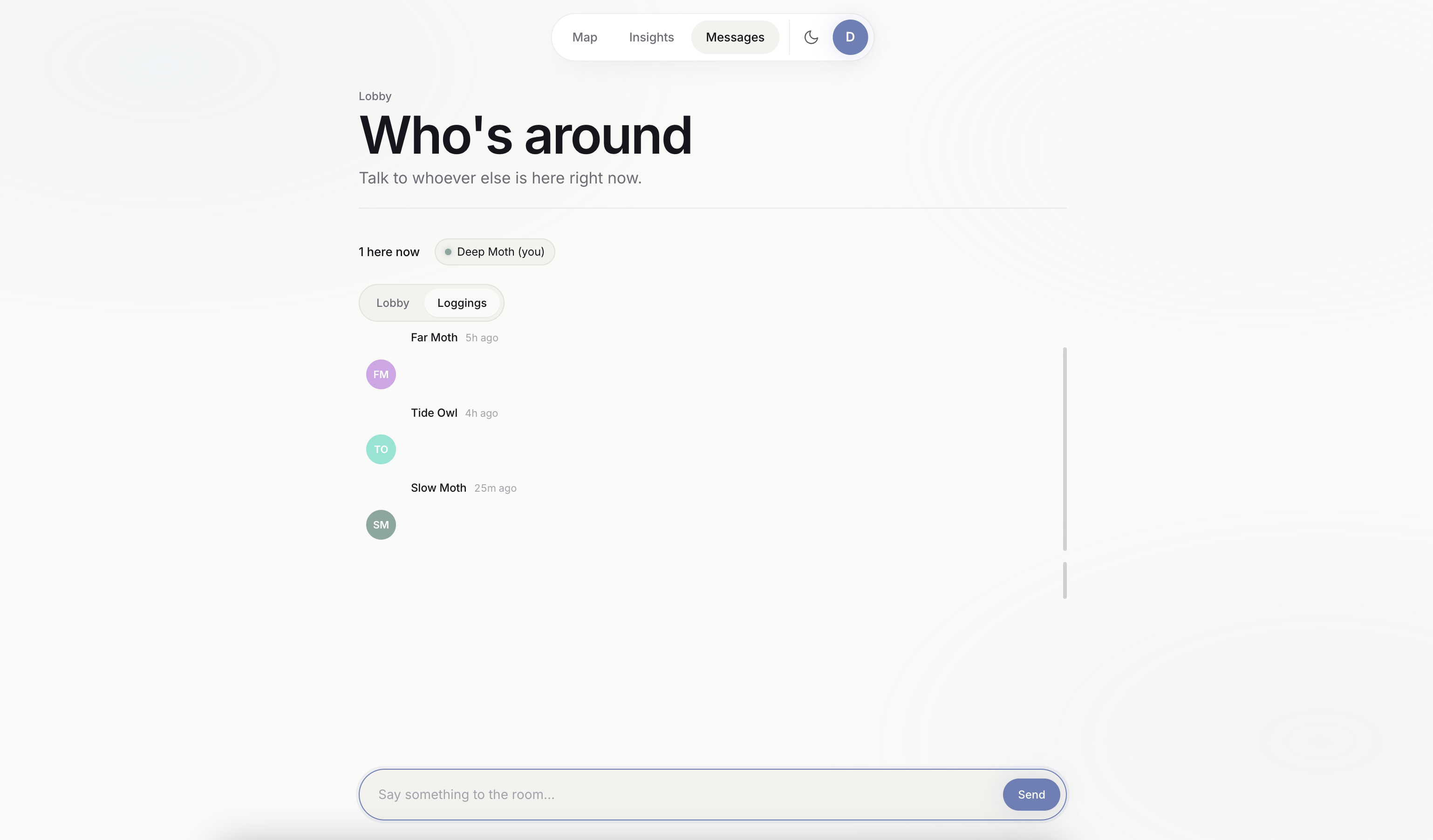
We pivoted to ensure just a single lobby that connects people without the weight of having to add and talk. There is no barrier to starting.
Kept (in spirit)
- Low-friction signal for support
- Anonymous-by-default sharing
- Co-presence as the social primitive
New
- Real-time lobby chat with whoever's around
- Auto-generated nature pseudonyms (Deep Moth, Tide Owl…)
- Lobby / Loggings toggle to switch between chat and a feed of nearby check-ins
Cut
- Friends list + friend profiles
- Friend's Landscape view
- Shared Journal between friends
- Active / Create Community flows
- Co-created Landscape
- Gamification, rewards, status light
Demo
Live prototype: log, reflect, and see shared emotions on the map.
This demo shows the core interaction loop: students record how they feel, receive AI-supported reflection, and view emotional messages connected to place in real time.
Impact
What this project is for.
Collecting and connecting people beyond Berkeley, bringing them together through low-friction associations grounded in physical GPS mappings.